
There are a few big decisions in life: Coke or Pepsi, buying or renting, city or suburbs? Well, I have one more big decision for you to consider: Noom or Weight Watchers?
Noom and Weight Watchers are two of the biggest names in weight loss, but they take very different approaches. How, you ask?
Noom focuses more on psychology and changing the habits behind how you eat, while Weight Watchers (WW) gives you a more structured system built around Points. Both now also offer medical weight-loss programs with access to GLP-1 medications, including popular options like Wegovy and Zepbound.
So, which weight loss program is better?
For most people, the answer comes down to what kind of support works best for you. Noom may be the better choice if you want to understand why you eat the way you do and work on changing those habits. Weight Watchers may be a better fit if you prefer simple rules, accountability, community support, and the option to attend workshops.
I’ve compared the two programs below, including cost, food tracking, coaching, GLP-1 medications, and some of the less obvious pros and cons that can make one program a much better fit than the other.
Noom vs WW: Comparison | Differences | Cost | Simplicity | GLP-1 | Better?
Noom vs. Weight Watchers: Quick Comparison
| Noom | Weight Watchers | |
|---|---|---|
| Best for | Psychology and behavior change | Structure & accountability |
| Food system | Calorie budget + color categories | Points system |
| Food tracking | Yes | Yes |
| Daily lessons | Yes | No |
| Community support | Limited | Strong |
| In-person workshops | No | Available with select plans |
| GLP-1 program | Noom Med | WeightWatchers Med+ |
| GLP-1 microdosing | Available | No dedicated microdosing program |
| Best if you… | Want to understand and change eating habits | Prefer simple rules and ongoing accountability |
The Short Version:
If you’re looking for the simplest way to think about Noom vs. Weight Watchers, here’s my take:
- Choose Noom if you’re interested in the psychology behind weight loss and don’t mind spending a few minutes each day on lessons, food tracking, and habit-building.
- Choose Weight Watchers if you’d rather have a straightforward system that tells you how foods fit into your day, especially if you like the idea of workshops, community support, and extra accountability.
Just like the decision of whether to buy or rent, neither one is always better. The “better” program is the one you’re actually likely to stick with for sustainable weight loss, and that’s where the differences between Noom and WW start to matter.
The Biggest Difference: Noom Psychology vs. WW Points
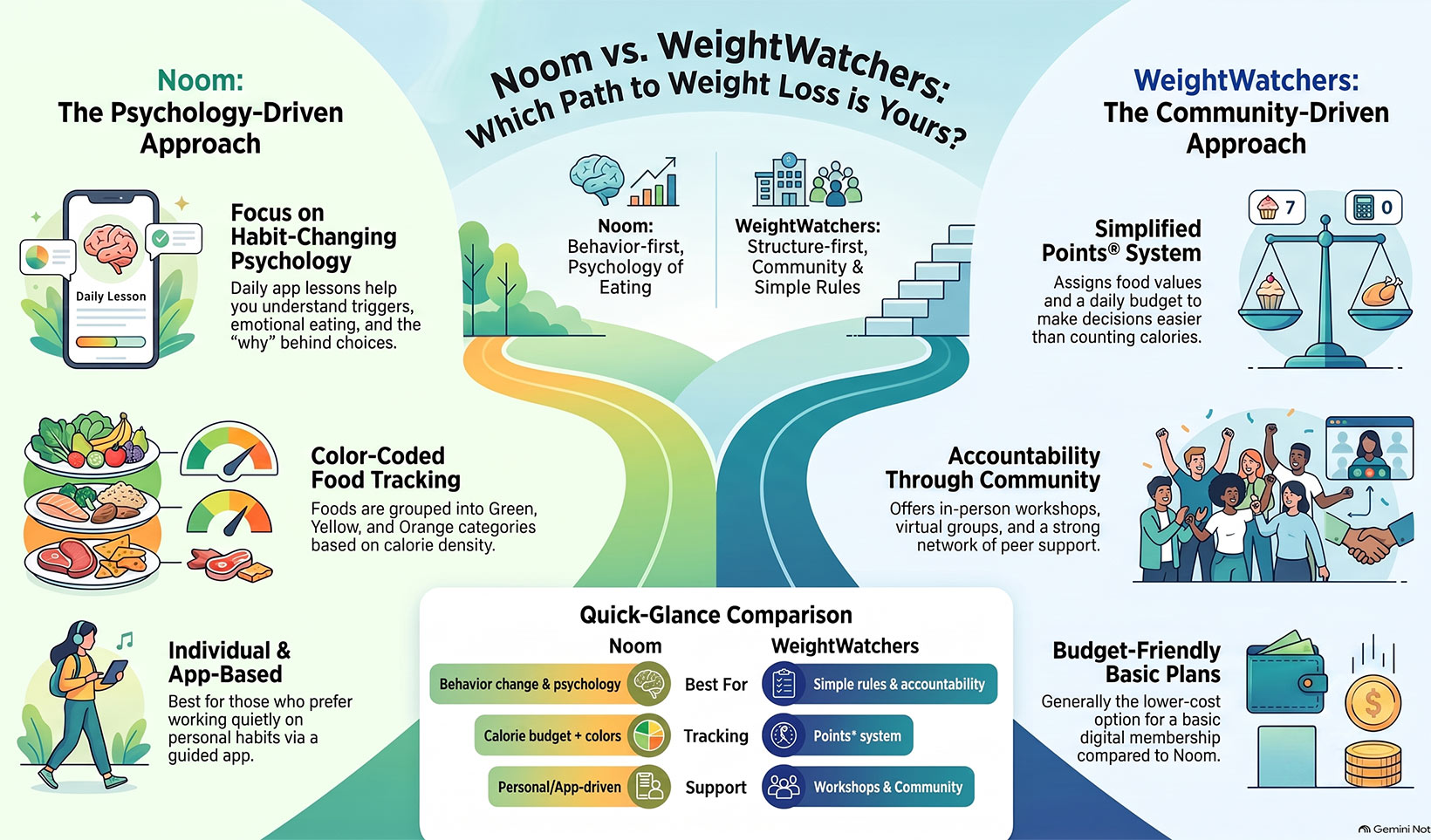
The biggest difference between Noom and Weight Watchers is really how they try to change the way you eat.
Noom is more psychology-focused. The program spends a lot of time helping you understand habits, triggers, emotional eating, and the little decisions that add up over time. Instead of just telling you what to eat, Noom tries to help you figure out why you make certain choices in the first place.
Weight Watchers is more structure-focused. Its Points system assigns foods a value and gives you a daily Points Budget to work with. The idea is to make food decisions easier without forcing you to count every calorie or completely avoid the foods you enjoy.
That’s why I tend to think of the two programs this way:
- Noom is behavior-first.
- Weight Watchers is structure-first.
Some people love Noom because it feels more like working on long-term habits. Others would rather skip the psychology lessons and have a simple system that tells them how a slice of pizza, a bowl of oatmeal, or a restaurant meal fits into the rest of their day.
Neither approach is necessarily better. It mostly depends on whether you respond better to understanding your habits or having clear rules to follow.
How Does Noom Work?

Noom is primarily an app-based weight-loss program that combines food tracking, daily lessons, activity tracking, and behavioral coaching.
When you sign up, Noom creates a personalized calorie target based on factors like your age, weight, activity level, and goals. You can then log your meals in the app and see how your food choices fit into that daily target.
Noom also groups foods into green, yellow, and orange categories based largely on calorie density. Green foods generally include things like fruits, vegetables, and other foods that help you feel full for fewer calories, while orange foods tend to be more calorie-dense. No foods are technically off-limits.
The part that makes Noom different from most traditional diet programs is the daily psychology lessons. These short lessons cover topics like emotional eating, motivation, habits, cravings, and all-or-nothing thinking.
In practice, that means Noom isn’t just asking, “What did you eat today?”
It’s also trying to get you to think about why you ate it, what was happening at the time, and what you might do differently next time.
That extra behavioral focus can be really useful if you’ve tried diets before and found yourself repeatedly slipping back into the same habits.
How Does Weight Watchers Work?

Weight Watchers takes a more structured approach through its Points® system.
Instead of counting calories directly, foods are assigned a Points value, and you’re given a personalized daily Points Budget. You can spend those Points however you want, which gives the program some flexibility without making food choices feel completely open-ended.
WW also includes ZeroPoint® foods, which generally include nutrient-dense options like fruits, vegetables, lean proteins, and other foods that don’t need to be tracked against your daily budget.
For some people, this makes eating decisions much easier. You don’t necessarily have to think through the psychology behind every snack or meal; you can simply look at how many Points it uses and decide whether it fits into your day.
Weight Watchers also puts more emphasis on community and accountability than Noom. Depending on your plan, you may have access to virtual or in-person workshops, group support, and coaching.
That can be a big advantage if you know you’re more likely to stay on track when other people are involved.
Noom vs. Weight Watchers Cost

Cost is another area where Noom and Weight Watchers can feel very different.
Weight Watchers is usually the less expensive option for a basic digital membership, especially when WW is running one of its frequent promotional offers. Noom tends to cost more, although its pricing can drop considerably when you commit to several months at a time.
The difference partly comes down to what you’re paying for. Noom includes its psychology-based lessons and behavior-change tools as a core part of the experience, while Weight Watchers‘ Core plan is more focused on Points, food tracking, recipes, and community features.
If you want WW workshops or additional support, the price goes up!
Both companies also offer separate medical weight-loss programs for people interested in GLP-1 medications. Those plans have their own pricing, and the cost of the medication itself may or may not be included depending on the program.
So if price is your main concern, Weight Watchers generally has the advantage for traditional weight loss. If you’re comparing their medical programs, though, it’s worth looking closely at exactly what’s included rather than comparing the monthly membership fee alone.
Food Tracking: Noom Calories & Colors vs. WW Points
Both Noom and Weight Watchers ask you to track what you eat, but the experience feels pretty different.
With Noom, you’re working with a calorie target and a color-based food system. Foods are grouped into green, yellow, and orange categories, which is meant to help you notice which foods give you more volume and nutrition for fewer calories.
With Weight Watchers, the focus is on Points rather than calories. You get a daily Points Budget, and each food has a Points value based on its nutritional profile.
The WW system is probably easier if you like having one simple number to work with. Noom gives you a little more nutritional context, but it can also feel more involved because you’re paying attention to calories, food categories, and your daily lessons at the same time.
The good news is that neither program bans specific foods. You can still have pizza, dessert, or a cheeseburger. The goal is to make those foods fit into the bigger picture rather than pretending you’ll never eat them again.
Coaching, Community, and Support
This is one area where the two programs have noticeably different personalities.
Noom is more individual and app-driven. Much of the support comes through the app, including lessons, tracking tools, coaching features, and prompts designed to keep you engaged with your goals.
Weight Watchers is stronger on community. WW has long built its program around the idea that losing weight can be easier when you’re doing it with other people. Depending on your membership, you may have access to virtual or in-person workshops, group support, and coaches.
If you prefer to work quietly on your own habits, Noom may feel like the better fit.
If you know you do better when you have regular accountability and other people cheering you on, Weight Watchers has a clear advantage here.
This is also one of the biggest reasons I wouldn’t choose between the two based on price alone. The program that gives you the kind of support you’ll actually use is usually the better value.
Which App Is Easier to Use? 🤔
Both Noom and Weight Watchers are built around their apps, so you’re going to spend a fair amount of time there no matter which program you choose.
WeightWatchers feels a little more straightforward. The app is mainly built around tracking food, checking Points, finding recipes, monitoring progress, and connecting with the WW community. If you like a simple “log it and move on” routine, it’s easy to get the hang of.
Noom asks a little more from you. In addition to logging meals and weight, you’re also working through daily lessons and behavioral exercises. That can make the app feel more engaging, but also a little more like homework.
So, for pure simplicity, I’d give Weight Watchers the edge.
For someone who wants more guidance, education, and habit-building built into the app, Noom may feel more useful.
Tip: Both programs have promotions for new customers. Check them out here: WW offers | Noom offers
Noom Med vs. WeightWatchers Med+: GLP-1 Programs
GLP-1 weight loss medications are hot, and you can incorporate them into either program if you qualify.
Noom Med combines Noom’s behavioral program with clinical care. Depending on the plan and your eligibility, treatment may include branded medications such as Wegovy or Zepbound, other prescription weight-loss medications, and Noom’s lower-dose GLP-1 options.
WeightWatchers Med+ provides clinical weight-management care through WeightWatchers Clinic. Eligible members can be evaluated for GLP-1 medications such as Wegovy and Zepbound while also using WW’s nutrition and lifestyle tools.
One important difference is pricing. With both companies, you need to look closely at whether the advertised monthly price includes only the clinical membership or also includes the medication itself. Prescription costs can vary dramatically depending on the medication, your insurance, and the specific plan.
Not ready to dive right in to taking GLP-1 medications? Consider Noom’s GLP-1 microdosing program, which uses a lower-and-slower dosing approach. If that’s appealing, you should also note that Weight Watchers does not currently have an equivalent dedicated microdosing program.🤔
Tip: If GLP-1 treatment is one of your main reasons for considering either company, I’d compare the medical programs separately from their standard weight-loss memberships. The differences in medication options, dosing, insurance support, and total cost can be much more important than the price of the basic app.
What You Might Not Like About Noom or Weight Watchers
Noom and Weight Watchers both have strengths, but neither is perfect.
The biggest downside of Noom is that it can feel like a commitment. The daily lessons, food logging, weigh-ins, and behavioral exercises are useful if you enjoy that kind of structure, but some people may start to feel like they’re doing homework.
Noom can also be more expensive than a basic Weight Watchers membership, especially if you’re paying month to month.
With Weight Watchers, the Points system is simple and flexible, but that can also be a weakness. It’s possible to get very good at “working the system” without really changing the habits behind your eating.
WW also makes more sense if you actually use its community features. If you have no interest in workshops, group support, or accountability, some of what makes Weight Watchers different may not matter much to you.
In other words, the better program is not necessarily the one with the longest feature list. It’s the one whose approach feels realistic enough to fir into your daily routine.
Which Is Better: Noom or Weight Watchers?
If you’re still deciding between Noom and Weight Watchers, I’d make the choice based on how you prefer to approach weight loss.
Choose Noom if you:
- Want to understand the habits and psychology behind your eating
- Like short daily lessons and guided behavior change
- Prefer a mostly app-based experience
- Don’t mind spending a little more for additional structure and education
- Are especially interested in Noom Med or its GLP-1 microdosing options
Choose Weight Watchers if you:
- Prefer a simple system for deciding what to eat
- Like the idea of tracking Points instead of calories
- Want community support or in-person workshops
- Respond well to accountability
- Want a lower-cost basic weight-loss program
For traditional weight loss, Weight Watchers probably has the edge on simplicity, price, and community, while Noom stands out for psychology, habit-building, and a more guided experience.
I don’t think there’s one clear winner for everyone. If you’ve struggled because you know what to eat but keep falling back into the same habits, Noom may be the more useful approach. If you mainly want an easier system for making everyday food decisions, Weight Watchers may be the better fit!
Noom vs. Weight Watchers FAQs
Noom may be better for behavior change and psychology, while Weight Watchers is better for simplicity, Points tracking, community support, and optional workshops. The best choice depends on which approach you’re more likely to stick with.
Noom focuses on psychology, habits, and calorie tracking, while Weight Watchers uses a Points system to simplify food choices. WW also offers more community support and in-person workshop options.
Weight Watchers is usually cheaper for a basic digital membership. Noom generally costs more, although monthly pricing can fall when you purchase a longer membership.
Weight Watchers is generally easier to follow because its Points system gives foods a simple value. Noom requires more daily involvement through calorie tracking, food categories, lessons, and behavioral exercises.
Yes. Noom offers GLP-1 treatment through Noom Med, while Weight Watchers offers medical weight-loss treatment through Med+ and WeightWatchers Clinic. Eligibility and medication costs vary.
No. Weight Watchers does not currently have a dedicated GLP-1 microdosing program. Noom offers a lower-dose GLP-1 program designed around slower dosing and clinical monitoring.
Weight Watchers may be easier for beginners who want straightforward food rules, while Noom may be better for people who want more education about habits, psychology, and long-term behavior change.
I hope we helped clarify the differences between Noom and Weight Watchers. Have you tried both programs? If so, let us know if you think one is better than the other.Thanks for stopping by Pretty Sweet!