

If you’re new to Weight Watchers, or even if you’ve been following the program for years, you may have wondered: How many calories are in one Weight Watchers Point?
It’s a reasonable question. After all, calories appear on every nutrition label, while Weight Watchers Points can sometimes feel like a mystery. The short answer is that there is no exact calorie-to-point conversion. However, we can estimate that one point equals about 30-50 calories.
However, understanding the relationship between calories and Points can help you make smarter food choices and estimate Point values when official information isn’t available. Here’s today’s best WW offer, plus a rough estimate of how many calories equal one WeightWatchers point.

The Short Answer: There Is No Fixed Conversion
Unlike calories, which simply measure the amount of energy in a food, Weight Watchers Points are designed to account for nutritional quality as well as quantity.
Because of this, two foods with the same number of calories can have very different Point values.
For example, a 200-calorie serving of grilled chicken breast may have a much lower Point value than a 200-calorie candy bar. That’s because Weight Watchers generally rewards nutrients such as protein and fiber while assigning more Points to foods that are high in added sugar and saturated fat.
As a result, there is no universal rule that says one Point always equals a specific number of calories. Having said that, we can still estimate about how many calories are in one Weight Watchers point.
So, About How Many Calories Is One Point?
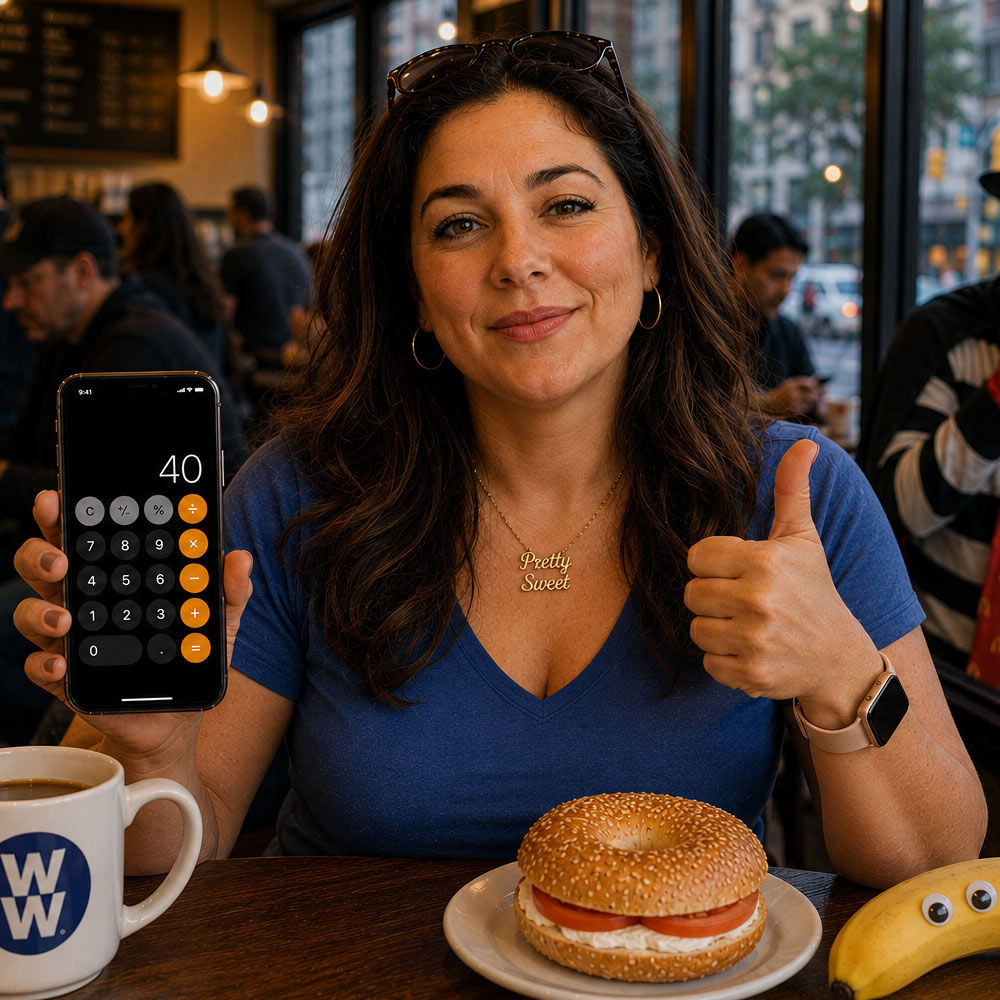
Although there is no official conversion, many Weight Watchers users find that one Point often works out to roughly 30 to 50 calories, depending on the food.
For many everyday packaged foods, an estimate of about 40 calories per Point is often reasonably close.
That doesn’t mean a 400-calorie meal will always be 10 Points. The nutritional makeup of the food matters just as much as the calorie count itself.
Foods that are high in protein may have fewer Points than expected, while foods high in sugar or saturated fat may have more.
Why Calories Alone Don’t Tell the Whole Story
Counting calories is an inferior way to evaluate foods! So, one of the main goals of the Weight Watchers Points system is to encourage foods that are more filling and nutritious.
Consider these examples:
- A serving of nonfat Greek yogurt may contain around 90 calories but have very few (or even zero) Points depending on the plan.
- A glazed doughnut may contain a similar number of calories but carry a much higher Point value.
- A grilled chicken breast may contain more calories than a sugary snack yet still have fewer Points because of its high protein content.
This approach encourages people to think beyond calories and consider how different foods fit into an overall healthy eating pattern.
Nutrients That Affect Weight Watchers Points
While Weight Watchers does not publish its exact formula, the company has explained that several nutritional factors influence Point values.
In general:
- Calories increase Points.
- Added sugar increases Points.
- Saturated fat increases Points.
- Protein lowers Points.
- Fiber lowers Points.
- Unsaturated fats may help lower Points in certain situations.
This means that two foods with identical calorie counts can end up with very different Point totals.
Related: Estimate Your Daily WW Points Budget Here!
Can You Estimate WW Points From Calories?
Yes, at least roughly.
If you only know the calorie count of a food and nothing else, dividing the calories by about 40 can provide a quick estimate.
For example:
- 120 calories ≈ 3 Points
- 200 calories ≈ 5 Points
- 320 calories ≈ 8 Points
- 400 calories ≈ 10 Points
Keep in mind that this is only a rough guideline. Foods that are especially high in protein or fiber may have fewer Points than expected, while foods high in sugar and saturated fat may have more.
A Better Approach: Use Nutrition Facts
Whenever possible, it’s better to estimate Weight Watchers Points using the full nutrition label rather than calories alone.
Looking at calories, protein, fiber, sugar, and saturated fat provides a much more accurate picture of how a food is likely to score within the Weight Watchers system.
That’s why WeightWatchers Points calculators, including the one on this site, use multiple nutritional factors instead of relying solely on calories.
Calorie to Point Conversion FAQs
Not exactly. There is no fixed calorie-to-Point conversion. Depending on the food, one Weight Watchers Point often represents roughly 30 to 50 calories, but factors such as protein, fiber, sugar, and saturated fat also affect the Point value.
There is no exact answer because Points are based on more than calories alone. However, 5 Points often corresponds to approximately 150 to 250 calories, depending on the food’s nutritional profile.
Foods high in added sugar and saturated fat may have higher Point values than expected. Weight Watchers is designed to encourage more filling, nutrient-dense foods rather than focusing on calories alone.
You can make a rough estimate by assuming that one Point is worth about 40 calories, but results may vary. Using a nutrition-based Points calculator is usually more accurate.
Quick to the Point, to the Point No Fakin’
So, how many calories are in one Weight Watchers Point?
There isn’t a single official answer. Depending on the food, one Weight Watchers Point is usually between 30 and 50 calories, with about 40 calories per Point serving as a useful rule of thumb. However, Weight Watchers Points are designed to consider more than calories alone, which is why foods with similar calorie counts can have very different Point values.
If you’re trying to estimate the Points in a food, the most accurate approach is to use a nutrition-based Points calculator that considers calories, protein, fiber, sugar, and fat together. That way, you’ll get a result that better reflects the way the Weight Watchers system is intended to work.
I hope we helped you estimate the number of calories in one Weight Watchers point, and thanks for stopping by Pretty Sweet!

I’m a dad of four, including 3 kids and a Hungarian Vizsla who is my partner about 22 hours a day. I’m a Philly sports fan and enjoy writing about wellness, saving money, and personal finance. Thanks for reading!