
There are a few big decisions in life: Coke or Pepsi, buying or renting, city or suburbs? Well, I have one more big decision for you to consider: Noom or Weight Watchers?
Noom and Weight Watchers are two of the best-known weight-loss programs, but they go about it in noticeably different ways.
Noom leans heavily on psychology, helping you recognize, and gradually change, the habits behind how you eat. Weight Watchers, or WW, offers a more structured approach built around its Points system. Both also have medical weight-loss programs that may provide eligible members with access to GLP-1 medications such as Wegovy and Zepbound.
So, which one is better? Honestly, it depends on what keeps you motivated!
Noom may be a better fit if you want to understand why you make certain food choices and work on changing those patterns. Weight Watchers may suit you better if you prefer clear guidelines, community support, accountability, and the option to attend workshops.
Below, I compare Noom and Weight Watchers on price, food tracking, coaching, GLP-1 options, and a few less obvious differences that could make one a much better fit for you.
Noom vs WW: Comparison | Differences | Cost | Simplicity | GLP-1 | Better?
Noom vs. Weight Watchers: Quick Comparison
| Noom | Weight Watchers | |
|---|---|---|
| Best for | Psychology and behavior change | Structure & accountability |
| Food system | Calorie budget + color categories | Points system |
| Food tracking | Yes | Yes |
| Daily lessons | Yes | No |
| Community support | Limited | Strong |
| In-person workshops | No | Available with select plans |
| GLP-1 program | Noom Med | WeightWatchers Med+ |
| GLP-1 microdosing | Available | No dedicated microdosing program |
| Best if you… | Want to understand and change eating habits | Prefer simple rules and ongoing accountability |
The Short Version:
If you’re looking for the simplest way to think about Noom vs. Weight Watchers, here’s my take:
- Choose Noom if you’re interested in the psychology behind weight loss and don’t mind spending a few minutes each day on lessons, food tracking, and habit-building.
- Choose Weight Watchers if you’d rather have a straightforward system that tells you how foods fit into your day, especially if you like the idea of workshops, community support, and extra accountability.
Just like the decision of whether to buy or rent, neither one is always better. The “better” program is the one you’re actually likely to stick with for sustainable weight loss, and that’s where the differences between Noom and WW start to matter.
The Biggest Difference: Noom Psychology vs. WW Points
The biggest difference between Noom and Weight Watchers is really how they try to change the way you eat.
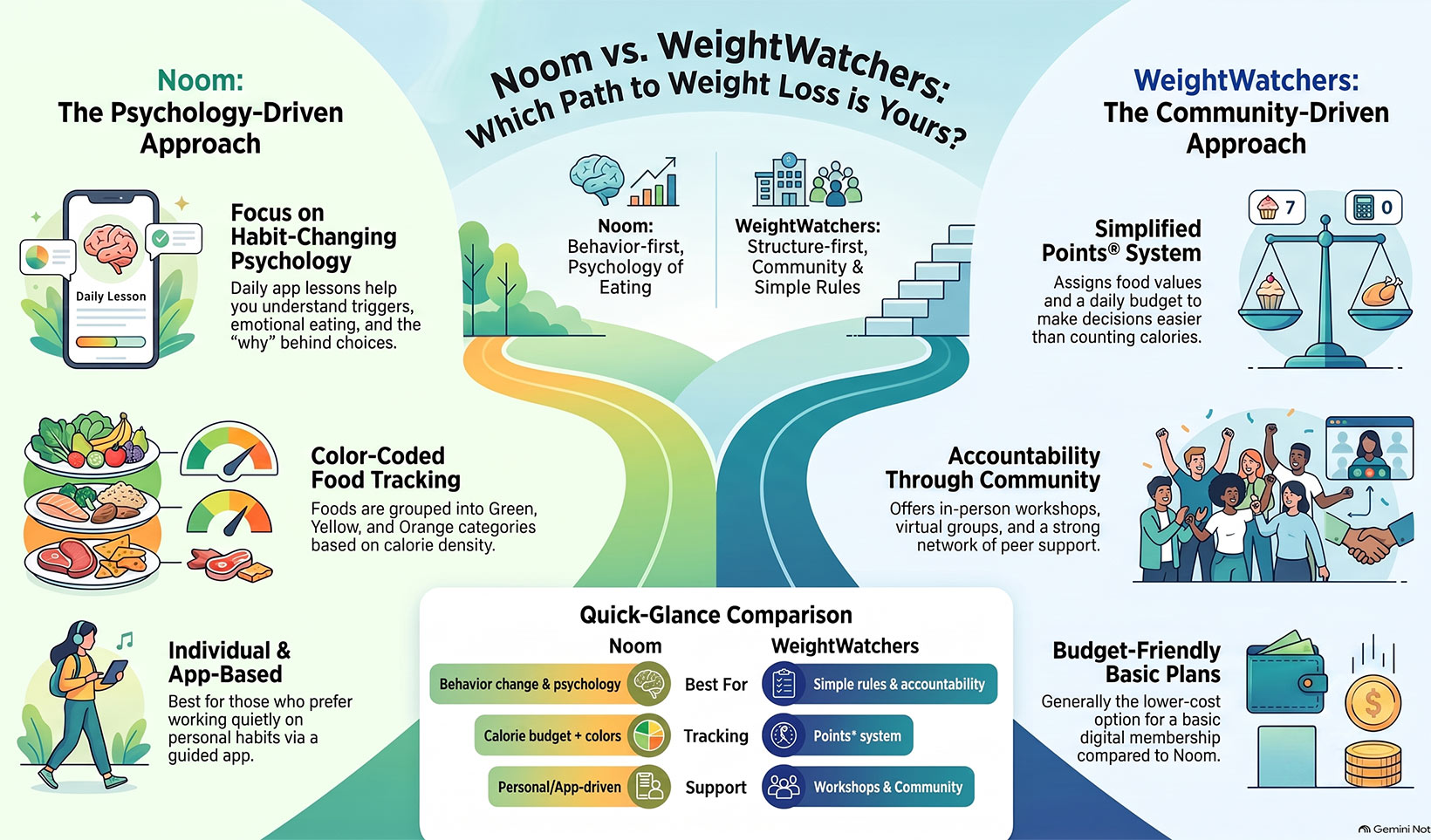
Noom is more psychology-focused. The program spends a lot of time helping you understand habits, triggers, emotional eating, and the little decisions that add up over time. Instead of just telling you what to eat, Noom tries to help you figure out why you make certain choices in the first place.
Weight Watchers is more structure-focused. Its Points system assigns foods a value and gives you a daily Points Budget to work with. The idea is to make food decisions easier without forcing you to count every calorie or completely avoid the foods you enjoy.
That’s why I tend to think of the two programs this way:
- Noom is behavior-first.
- Weight Watchers is structure-first.
Some people love Noom because it feels more like working on long-term habits. Others would rather skip the psychology lessons and have a simple system that tells them how a slice of pizza, a bowl of oatmeal, or a restaurant meal fits into the rest of their day.
Neither approach is necessarily better. It mostly depends on whether you respond better to understanding your habits or having clear rules to follow.
How Does Noom Work?

Noom is mainly an app-based weight-loss program, but there’s more to it than counting calories. It combines food and activity tracking with short daily lessons designed to help you understand, and change, the habits behind how you eat.
After you sign up, Noom gives you a personalized calorie target based on your age, weight, activity level, and goals. As you log meals, the app shows how your choices fit into that daily target.
Foods are also sorted into green, yellow, and orange categories, largely according to calorie density. Fruits, vegetables, and other foods that help fill you up for fewer calories usually fall into the green category. More calorie-dense foods tend to be orange. Nothing is completely off-limits; the colors are meant to guide your portions, not label foods as “good” or “bad.”
What really separates Noom from a typical calorie-tracking app, though, is its focus on psychology. The daily lessons explore emotional eating, cravings, motivation, habits, and the all-or-nothing thinking that can turn one indulgent meal into an abandoned diet.
In other words, Noom doesn’t just ask what you ate. It encourages you to notice why you ate it, what was happening at the time, and what you could try next time.
That can be especially helpful if you already know the basics of healthy eating but keep finding yourself falling back into the same old patterns.
How Does Weight Watchers Work?

Weight Watchers takes a more structured approach, built around its familiar Points® system.
Rather than counting calories yourself, you’re given a personalized daily Points Budget, and each food has its own Points value. You can use those Points however you like, so there’s still room for pizza, dessert, or a meal out; you just have to decide how it fits into your day.
WW also has ZeroPoint® foods, including many fruits, vegetables, lean proteins, and other nutritious staples. These foods don’t need to be weighed, measured, or counted against your daily budget, which can make planning meals considerably easier.
That simplicity is one of WW’s biggest strengths. You don’t have to examine the psychology behind every snack. Sometimes you just want to know how many Points something costs and whether you have room for it.
WW also places more emphasis on community and accountability than Noom. Depending on your membership, you may be able to attend virtual or in-person workshops and connect with coaches and other members. If you’re more likely to stick with a plan when other people are involved, that support can make a real difference.
Noom vs. Weight Watchers Cost

Price is another area where Noom and Weight Watchers start to feel quite different.
For a basic digital membership, Weight Watchers is usually the cheaper option, especially during one of its frequent promotions. Noom often costs more, although choosing a longer subscription can bring down the effective monthly price.
Of course, you aren’t paying for exactly the same experience. Noom builds its psychology lessons and behavior-change tools into the program, while the WW Core plan centers on Points, food tracking, recipes, and community features. If you want access to WW workshops or more hands-on support, expect the price to increase.
Both companies also have separate medical weight-loss programs for people considering GLP-1 medications. Pricing gets a little murkier there because medication may be included with some plans but charged separately with others.
My take? If you mainly want an affordable, traditional weight-loss program, WW usually wins on price. When comparing the medical options, ignore the promotional starting price for a moment and look at the full monthly cost, including medication, clinical care, and any required commitment.
Food Tracking: Noom Calories & Colors vs. WW Points
Both Noom and Weight Watchers have you track what you eat, but using the two apps feels surprisingly different.
With Noom, you track calories while foods are sorted into green, yellow, and orange categories. The colors are meant to steer you toward foods that are more filling for fewer calories—not make you feel guilty about eating something orange.
Weight Watchers simplifies everything into Points. You get a daily Points Budget, and each food is assigned a value based on its nutritional makeup.
WW may feel easier if you like having one number to manage. Noom provides more context about your choices, but it also asks you to juggle calories, color categories, and daily lessons. Some people will find that helpful; others may find it a bit much.
Thankfully, neither program expects you to swear off pizza, cheeseburgers, or dessert forever. You can still eat the foods you enjoy; the idea is to make them work within your overall plan.
Coaching, Community, and Support
This is where Noom and Weight Watchers really show their different personalities.
Noom is more private and app-driven. Most of the experience happens on your phone through food tracking, daily lessons, coaching tools, and occasional prompts to keep you moving toward your goals. If you’d rather work on your habits quietly and at your own pace, that may be exactly what you want.
Weight Watchers is much more community-oriented. Depending on your membership, you can attend virtual or in-person workshops, connect with coaches, and get support from other members going through the same process.
Neither approach is automatically better. If you’re self-motivated, Noom may give you all the support you need. If accountability, and a few people cheering you on, helps keep you from drifting, WW has the advantage.
That’s also why I wouldn’t choose based on price alone. The program you’ll actually open, attend, and use is almost always the better value.
Which App Is Easier to Use? 🤔
Both Noom and Weight Watchers are built around their apps, so you’re going to spend a fair amount of time there no matter which program you choose.
WeightWatchers feels a little more straightforward. The app is mainly built around tracking food, checking Points, finding recipes, monitoring progress, and connecting with the WW community. If you like a simple “log it and move on” routine, it’s easy to get the hang of.
Noom asks a little more from you. In addition to logging meals and weight, you’re also working through daily lessons and behavioral exercises. That can make the app feel more engaging, but also a little more like homework.
So, for pure simplicity, I’d give Weight Watchers the edge.
For someone who wants more guidance, education, and habit-building built into the app, Noom may feel more useful.
Tip: Both programs have promotions for new customers. Check them out here: WW offers | Noom offers
Noom Med vs. WeightWatchers Med+: GLP-1 Programs
GLP-1 weight loss medications are hot, and you can incorporate them into either program if you qualify.
Noom Med combines clinical care with Noom’s usual focus on habits and behavior change. Depending on your eligibility and the plan you choose, treatment may include Wegovy, Zepbound, another prescription weight-loss medication, or one of Noom’s lower-dose GLP-1 options.
WeightWatchers Med+ takes a similar all-in-one approach through WeightWatchers Clinic. Eligible members can meet with a clinician, be evaluated for medications such as Wegovy or Zepbound, and continue using WW’s food-tracking and lifestyle tools.
Here’s where you need to read the fine print: the advertised monthly price may cover only the clinical membership, and not the medication. Your actual cost can vary quite a bit depending on the prescription, your insurance coverage, and what’s included with the plan.
Curious about GLP-1 treatment but interested in a lower-dose approach? Noom also advertises a clinician-guided GLP-1 Microdose program. Weight Watchers doesn’t currently offer a comparable program specifically built around microdosing.🤔
Tip: If GLP-1 treatment is your priority, compare the medical programs, and not just the apps. Medication options, insurance coverage, dosing, and total cost will matter far more than the basic membership price.
What You Might Not Like About Noom or Weight Watchers
Noom and Weight Watchers both have plenty going for them, but let’s be honest: neither one is perfect.
With Noom, the biggest drawback is that it can feel like work. The daily lessons, meal logging, weigh-ins, and exercises can be helpful, right up until they start feeling like homework. It’s also usually more expensive than a basic WW membership, especially if you pay month to month.
Weight Watchers is simpler, but that simplicity has a downside too. You can become very good at fitting foods into your Points Budget without necessarily changing the habits that caused you trouble in the first place.
WW’s community is also a big part of its appeal. If you have no interest in workshops, group support, or regular accountability, you may not get much value from what makes the program different.
Ultimately, the best program isn’t the one with the most features. It’s the one that feels realistic enough to become part of your life, not another chore you’ll abandon in a month.
Which Is Better: Noom or Weight Watchers?
If you’re still deciding between Noom and Weight Watchers, I’d make the choice based on how you prefer to approach weight loss.
Choose Noom if you:
- Want to understand the habits and psychology behind your eating
- Like short daily lessons and guided behavior change
- Prefer a mostly app-based experience
- Don’t mind spending a little more for additional structure and education
- Are especially interested in Noom Med or its GLP-1 microdosing options
Choose Weight Watchers if you:
- Prefer a simple system for deciding what to eat
- Like the idea of tracking Points instead of calories
- Want community support or in-person workshops
- Respond well to accountability
- Want a lower-cost basic weight-loss program
For traditional weight loss, Weight Watchers probably has the edge on simplicity, price, and community, while Noom stands out for psychology, habit-building, and a more guided experience.
I don’t think there’s one clear winner for everyone. If you’ve struggled because you know what to eat but keep falling back into the same habits, Noom may be the more useful approach. If you mainly want an easier system for making everyday food decisions, Weight Watchers may be the better fit!
Noom vs. Weight Watchers FAQs
Noom may be better for behavior change and psychology, while Weight Watchers is better for simplicity, Points tracking, community support, and optional workshops. The best choice depends on which approach you’re more likely to stick with.
Noom focuses on psychology, habits, and calorie tracking, while Weight Watchers uses a Points system to simplify food choices. WW also offers more community support and in-person workshop options.
Weight Watchers is usually cheaper for a basic digital membership. Noom generally costs more, although monthly pricing can fall when you purchase a longer membership.
Weight Watchers is generally easier to follow because its Points system gives foods a simple value. Noom requires more daily involvement through calorie tracking, food categories, lessons, and behavioral exercises.
Yes. Noom offers GLP-1 treatment through Noom Med, while Weight Watchers offers medical weight-loss treatment through Med+ and WeightWatchers Clinic. Eligibility and medication costs vary.
No. Weight Watchers does not currently have a dedicated GLP-1 microdosing program. Noom offers a lower-dose GLP-1 program designed around slower dosing and clinical monitoring.
Weight Watchers may be easier for beginners who want straightforward food rules, while Noom may be better for people who want more education about habits, psychology, and long-term behavior change.
I hope we helped clarify the differences between Noom and Weight Watchers. Have you tried both programs? If so, let us know if you think one is better than the other.Thanks for stopping by Pretty Sweet!

I’m a dad of four, including 3 kids and a Hungarian Vizsla who is my partner about 22 hours a day. I’m a Philly sports fan and enjoy writing about wellness, saving money, and personal finance. Thanks for reading!