
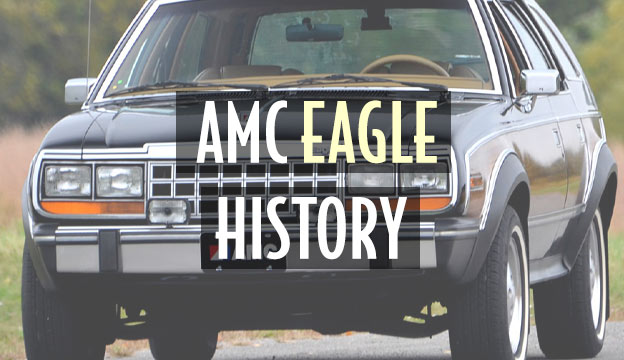
Long before every parking lot had a forest of crossovers, American Motors (AMC) built a vehicle that combined the comfort of a family car with the traction and ground clearance of a four-wheel-drive truck. It was called the AMC Eagle, and in 1980 it looked wonderfully strange and intrepid.
I should know, as I grew up with an Eagle as our family car, and inherited it when I got my driver’s license!
The AMC Eagle was not quite a station wagon, not quite a Jeep, and certainly not a conventional truck or SUV. It had the long roof, optional faux wood trim, and comfortable interior of a suburban family wagon, but it sat high in a stealthy crouch, with 4WD and chunky tires beneath flared fenders.
The AMC Eagle looked like an ordinary station wagon that had gone to Boy Scout (Eagle Scout?) camp for the Summer, and come home with self-confidence, bulging calves, and survival skills.
Today, the AMC Eagle is widely remembered as the first true crossover vehicle, and here’s its story:
AMC Eagle: Origin | Car & Driver Review | Eagle has landed | Vintage ads | Back to the Future | Cameos | History | FAQs
Why AMC Built the Eagle:

American Motors Corporation (AMC) was never as big or wealthy as GM, Ford, or Chrysler. In fact, they were a lot like the underdog ABA was to pro basketball in the 1970s, who also survived by being scrappy and nimble.
AMC found opportunities that the auto industry giants overlooked. After acquiring Jeep in 1970, they gained the valuable four-wheel-drive expertise that would make designing the Eagle possible years later.
By the late 1970s, rising fuel prices were pushing buyers away from oversized, gas-hungry vehicles, and product planner Roy Lunn and his team saw an opening. What if comfort of a passenger car was combined with the all-weather capability of a Jeep?
Like Dr. Frankenstein, Lunn and his team quickly went to work. With an electrical storm raging outside their design laboratory in Detroit, they began assembling and combining the pieces. First, they used the compact Concord as the foundation. Then, they raised the suspension and added four-wheel drive, 15-inch wheels, aggressive all-season tires, roof rails, and fender flares for a tougher look.
Lightning struck their lab, and the monster opened its eyes. The innovative crossover would debut to the public in August 1979 as the 1980 AMC Eagle.
AMC Eagle name origin: “Eagle” was chosen because AMC wanted to evoke a sense of rugged, American capability, acting as a nod to their successful Jeep brand and symbolizing the vehicle’s unique ability to “soar” over poor weather conditions and off-road terrain.
The Eagle was offered as a coupe, sedan, and wagon, to massive initial excitement and demand, fueled further by a glowing review in the well-respected Car & Driver Magazine.
A Glowing First Review From Car & Driver:

“We marvel as AMC’s ugly duckling becomes an eminently successful bird of prey.” – Car and Driver, 1980
When Car and Driver got their hands on the 1980 AMC Eagle, they weren’t just testing a new car; they were witnessing the birth of a whole new species. While the auto industry was skeptical of AMC’s plan to throw a four-wheel-drive system under a Concord body, the reviewers were quick to point out that this was not just a Jeep with a car shell.
The Eagle was something entirely new for Detroit: a spacious compact car with full-time four-wheel drive; essentially a “grown-up Subaru”. Car and Driver praised:
“It’s got to be the most impressive piece of automobile engineering in America today.”..”
“The heady success of the Eagle can only be explained in terms of all-round automotive goodness, plus four-wheel drive, because it doesn’t feature the kind of beauty that would launch a bass boat, let alone a thousand ships…”
“This is the first time we’ve been so unanimously impressed with an American Motors product, and we’re all a little bemused by our own enthusiasm… The Eagle has landed and is about to scream.”
“On pavement, the Eagle will pick ’em up and put ’em down with an aplomb never before felt in a four-wheel-drive whatever. Inside is serenity. It gets better. Nothing changes when the pavement ends… Hot damn!” (You can read the entire review here)
The Car and Driver review team was so enamored with the Eagle that Editor David E. Davis Jr. went out and immediately bought 200 shares of American Motors stock. (Oops!)

In fact, the reviewers liked the Eagle so much that they decided not to return the test car, instead keeping it as a long-term project vehicle. Coming from one of the most respected names in automotive journalism, that was a powerful endorsement, and for scrappy little AMC, the Eagle’s early success must have felt like a thrilling victory.
1980: The Eagle Has Landed!

By the time Car and Driver published its glowing review calling the AMC Eagle a smash hit, the car was already back-ordered for six months. Demand was so strong that AMC even dropped the Pacer to free up factory space for more Eagles.
It’s easy to see why the wagon became the star of the lineup. It offered the best mix of Eagle virtues: useful cargo space, four doors, family comfort, and the confidence of extra traction. Add the optional wood-grain siding, roof rack, and big windows, and you had a car that somehow blended early-1980s suburban splendor with genuine rugged appeal.
Reviewers said the Eagle’s secret sauce was its combination of four-wheel drive, aggressive all-season tires, independent front suspension, and improved braking. Together, those features gave it a surprisingly smooth, almost “European” feel. The Eagle wasn’t just good in mud and snow, either. Critics praised it as a genuinely enjoyable highway car, with better control, stability, and steering feedback than almost any American car of its time.
Vintage 1980s AMC Eagle Magazine Ads
Wow, these Eagle ads took a long time to locate and restore! Click on any advertisement to see a larger version, and feel free to share or Pin. (Also, I’d love a link back to this page!)


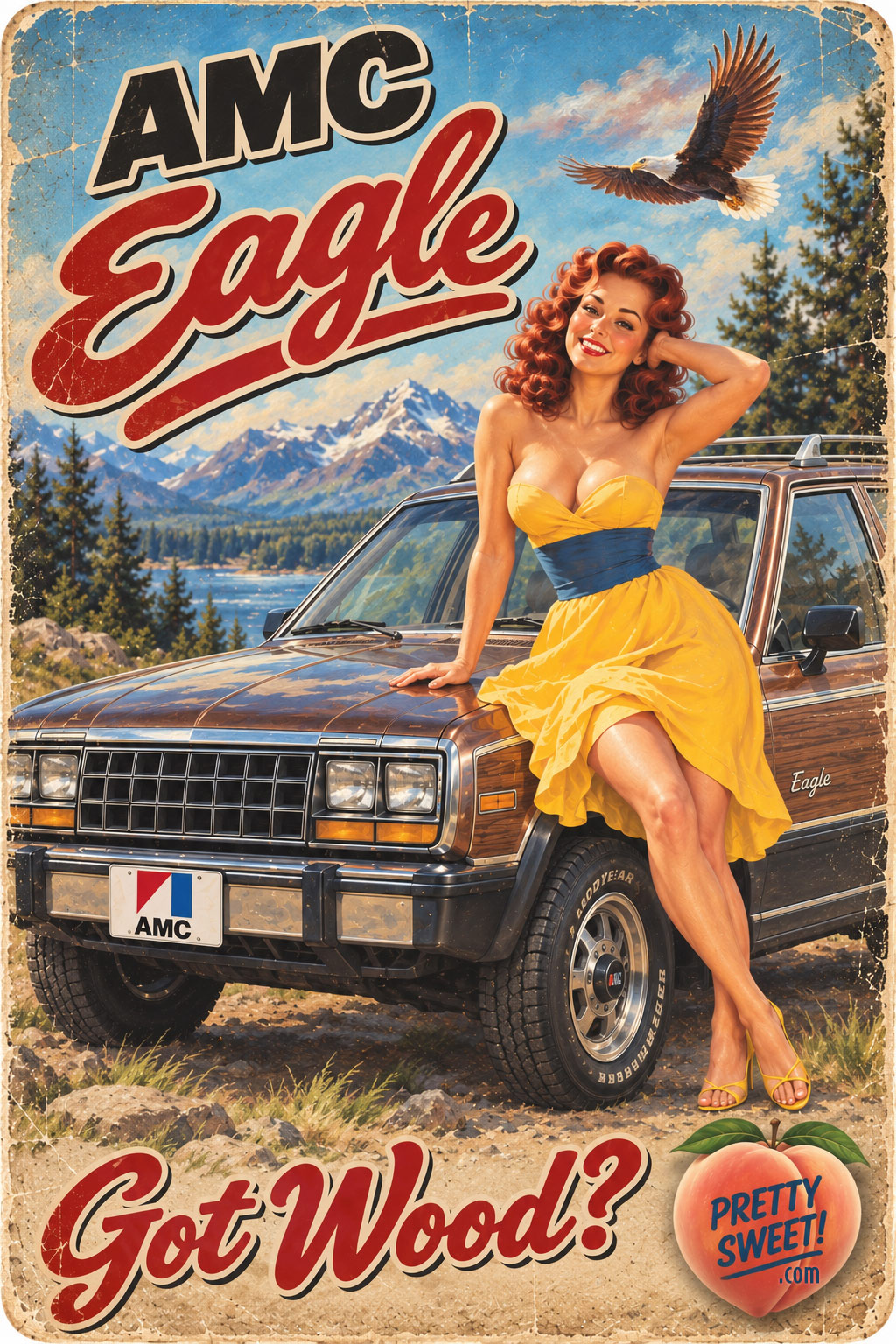
The Eagle was a unique, versatile car that looked perfectly natural outside a ski lodge, 2-car garage, or Pizza Hut with a salad bar… Or, even in a major motion picture?
Eagle Movie Cameo: Back to the Future!

The AMC Eagle also made numerous cameos in 80s movies and TV shows, and its brief appearance in Back to the Future (1985) solidified the car in 80s pop culture.
Want to go eagle watching? You’ll spot the car just after Marty McFly accepts a “Save the Clock Tower!” flyer in downtown Hill Valley. Moments later, his girlfriend’s father arrives in the Eagle to pick her up, setting the stage for the famous “Power of Love” scene.
We queued up the scene for you here:
Since time travel is possible, I’d like to think there’s a version of the movie Back to the Future that features the AMC Eagle as the star. Maybe something like this:

Either way, Back to the Future wasn’t the only time the AMC Eagle made a guest appearance in a movie or tv show.
AMC Eagles in Movies and TV
While it never had a lead role like the famous DeLoreon, AMC Eagle wagons have also had bit parts in other productions, like when Clark Griswold gassed up his station wagon next to an Eagle in National Lampoon’s Vacation (1983), and Robert Deniro drove behind one in Midnight Run (1988).


Also, a pretty sweet 1981 Eagle wagon was also featured prominently in Season 5 of Better Call Saul during a flashback to 1984 when young Kim refuses to get into the car with her mother, who is late and has been drinking. Check it out:

Come on, Kim, get in! That’s an iconic AMC Eagle wagon, and very safe in the snow!
Just watch as the Eagle steals the scene from what’s her name:
AMC Eagle History Timeline

- 1972 – The first Eagle prototype: AMC engineers build an early prototype to see whether a four-wheel-drive system could work beneath a unibody passenger car. The experiment proves the basic idea is possible, even if the production version is still years away.
- 1976 – Serious development begins: With fuel prices rising and Americans looking for more practical vehicles, AMC launches a concentrated development program. Engineer Roy Lunn and his team begin refining the unusual idea of combining everyday car comfort with Jeep-like traction.
- April 1977 – The Concord-based test car is built: AMC sends a preproduction Concord Sportabout wagon to Ferguson Formula Developments for four-wheel-drive engineering and testing. The humble family wagon is about to become the foundation for something genuinely new and awesome.
- August 1979 – The AMC Eagle makes its debut: AMC introduces the Eagle for the 1980 model year as a coupe, sedan, and station wagon. Its raised suspension, full-time four-wheel drive, larger tires, and passenger-car body create a combination unlike anything else being built in America.
- 1980 – The Eagle becomes an early hit: Buyers quickly embrace the Eagle, particularly the practical station wagon. Strong reviews and snowy-weather appeal help turn the inventive new model into a much-needed success for AMC.
- 1981 – The Eagle family expands: AMC adds the sporty SX/4 liftback and the smaller Kammback to the lineup. The SX/4 gives the Eagle a younger, more adventurous personality and becomes one of the most memorable versions of the car.
- 1982 – Select Drive arrives: AMC introduces its Select Drive system, allowing drivers to switch between two-wheel drive and four-wheel drive. The feature promises better fuel economy while preserving the Eagle’s reassuring all-weather capability.
- 1983 – AMC begins trimming the lineup: Slower-selling versions, including the Kammback and two-door sedan, disappear as AMC works to reduce costs and simplify production. The wagon remains the clear favorite among Eagle buyers.
- 1984 – The Eagle becomes mostly a wagon: The SX/4 is discontinued, leaving the sedan and wagon to carry the Eagle name. Production also shifts to Brampton, Ontario, as AMC reorganizes its factories around newer models.
- 1985–1986 – Sales begin to fade: The Eagle is still useful and distinctive, but its aging body and limited advertising begin to catch up with it. Annual sales fall sharply as AMC directs more of its scarce resources toward Jeep.
- 1987 – Chrysler purchases AMC: Chrysler acquires American Motors, primarily to gain control of the increasingly valuable Jeep brand. Eagle production continues briefly while the new owner decides what to keep and what to retire.
- December 14, 1987 – The final Eagle is built: The last Eagle wagon rolls off the Brampton assembly line. The final 2,306 cars are sold as 1988 models, bringing the original Eagle’s remarkable nine-year flight to an end.
- 1988 and beyond – The idea outlives the car: Chrysler keeps the Eagle name for a new division, but the original crossover concept disappears from showrooms. Ironically, the Eagle’s basic formula—car-like comfort, extra ground clearance, and all-weather traction—would soon become one of the most successful ideas in the entire auto industry.
Was the AMC Eagle the First Crossover?
Calling any vehicle the “first crossover” is a great way to start an argument among car enthusiasts. Subaru, for example, had been selling a four-wheel-drive station wagon in the United States since 1975. Still, the AMC Eagle is widely regarded as America’s first true crossover, and it has a very convincing claim.
The Eagle combined the body and comfortable interior of an ordinary passenger car with a raised ride height, larger tires, and full-time four-wheel-drive capability. It delivered much of the confidence and versatility of a Jeep without asking buyers to live with the bulk, rough ride, or utilitarian character of a traditional truck-based 4×4.
The AMC Eagle was also the only four-wheel-drive passenger car being manufactured in the United States at the time. In both appearance and purpose, the Eagle has far more in common with a modern Subaru Outback or compact crossover than it did with the sedans, wagons, and Jeeps sharing American roads in the early 1980s.
AMC had identified the future. Unfortunately, they built the Eagle before most buyers fully realized they wanted it.
Why it Failed: The End of the AMC Eagle’s Flight
While an eagle can live for 30 years in the wild, AMC’s species had a much shorter lifespan. The Eagle remained in production for roughly nine years, but as sales began to fade in the mid-1980s, AMC clipped its wings and directed its limited money and attention toward the increasingly valuable Jeep brand.
In 1987, Chrysler purchased AMC, largely to acquire Jeep, and Eagle production ended that December. The final 2,306 cars to leave the assembly line were sold as 1988 models, quietly closing the book on one of AMC’s most imaginative creations.
The Eagle name lived on as a Chrysler division, appearing on 1990s models such as the Eagle Talon. But aside from the bird-themed badge, those cars had little connection to AMC’s pioneering crossover. The original Eagle was gone, yet the idea behind it was just beginning to take flight. Within a few decades, nearly every major automaker would be building vehicles based on the same basic formula.
Why the AMC Eagle Still Matters


Sure, the AMC Eagle wasn’t especially fast or sleek. Its carbureted engine could be temperamental, it was prone to rust, and it had a few classic AMC quirks. But honestly, the Eagle was a genuine trailblazer; a car designed to solve problems most families had not yet realized they had.
Long before crossovers filled every suburban driveway, the Eagle was proving that one vehicle could handle school pickups, a snowy commute, and a muddy back road. With four-wheel drive, a raised suspension, roomy seating, and optional wood-grain panels, the Eagle offered a practical and slightly eccentric alternative to both bulky trucks and low-slung passenger cars.
The AMC Eagle is more than an old car. It’s a lovable, four-wheel-drive time capsule, and a wonderfully quirky, groundbreaking American hero.
Like most innovators, the Eagle might have been too early on the scene. However, this rugged, wood-paneled pioneer laid the foundation for the modern SUVs and changed the entire automotive industry.

Why would I spend hours restoring old AMC Eagle magazine ads and writing this post? My Eagle was part of our family and a piece of my childhood, and I’m happy to preserve a little piece of that nostalgia to share with others!
AMC Eagle History FAQs
The AMC Eagle is widely regarded as America’s first true crossover. It combined a comfortable passenger-car body with four-wheel drive, increased ground clearance, and rugged tires decades before modern crossovers became common.
The AMC Eagle debuted for the 1980 model year and remained in production through 1988. Chrysler sold the final 2,306 wagons after purchasing AMC in 1987.
AMC marketed the Eagle as a four-wheel-drive passenger car. Its innovative full-time system used a viscous coupling to distribute power smoothly without the binding associated with many traditional 4WD systems.
Most AMC Eagles were powered by AMC’s durable 4.2-liter inline-six. A smaller 2.5-liter four-cylinder was also offered in limited numbers, but the six-cylinder engine was far more common.
The Eagle originally came as a two-door coupe, four-door sedan, and station wagon. AMC later added the sporty SX/4 liftback and compact Kammback, although the wagon became the best-known and longest-lasting version.
Sales declined as the Eagle aged, while financially troubled AMC shifted its attention toward Jeep and newer Renault-based cars. Chrysler purchased AMC in 1987 and ended Eagle production later that year.
Did you have an AMC Eagle growing up? If so, let me know in the comments below, and thanks for visiting PrettySweet.com!

I’m a dad of four, including 3 kids and a Hungarian Vizsla who is my partner about 22 hours a day. I’m a Philly sports fan and enjoy writing about wellness, saving money, and personal finance. Thanks for reading!

Here’s a great story on Substack featuring a 1980 AMC Eagle wagon that you should read! https://open.substack.com/pub/f3chap/p/the-far-country-a-prodigal-story-acb