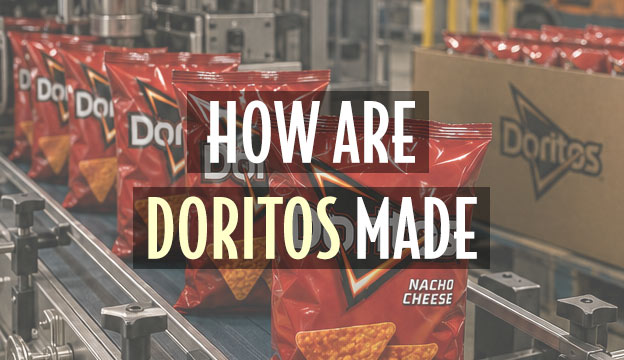
Have you ever found yourself tearing into a bag of Doritos, like a wild animal with orange finger tips, unable to stop eating them? That irresistible cheesy flavor is partly due to monosodium glutamate (aka msg), which is one of the dozens of ingredients in the secret formula.
Recently, during one of these epic personal battles of willpower against a bag of Doritos, I pondered where these tempting triangular guilty pleasures come from, and what brilliantly sinister factory process created them.
A little research shows that Doritos are made in large Frito-Lay plants across the United States, including major facilities in Casa Grande, Arizona, and Perry, Georgia. Regional factories help supply stores efficiently and keep distribution closer to local markets.
OK, the next question is how are Doritos made? If you have a few minutes, I recommend watching this video that shows a behind-the-scenes look at how Doritos chips are manufactured!
How Doritos Are Made in a Factory:
OK, I hope you caught all of that! If not, here’s a step-by-step summary of how Doritos are made:
Step 1: From Corn to Masa
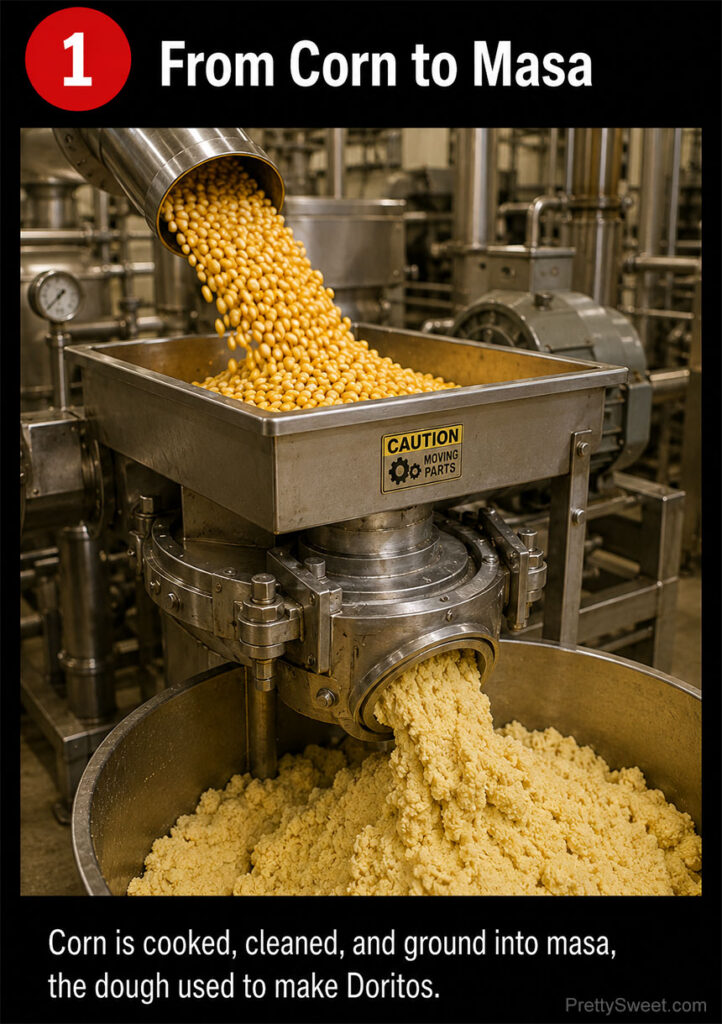
The process of making Doritos kicks off with high-quality corn sourced from farms and transported to the manufacturing plant. To turn this corn into Masa (the dough base for the chips), it undergoes a process called nixtamalization, where the corn is washed and soaked in water and lime for several hours.
This softens the kernels and removes the outer layer, making them easy to grind into a fine dough using specialized machinery. During this stage, experts closely monitor moisture, temperature, and texture to ensure the Masa is of the highest quality.
Doritos origin: Doritos began at Casa de Fritos, a Mexican-style restaurant in Disneyland’s Frontierland. Workers reportedly fried and seasoned leftover tortilla pieces instead of throwing them away, creating the snack that eventually caught Frito-Lay’s attention.
Step 2: The Iconic Doritos Triangle Shape
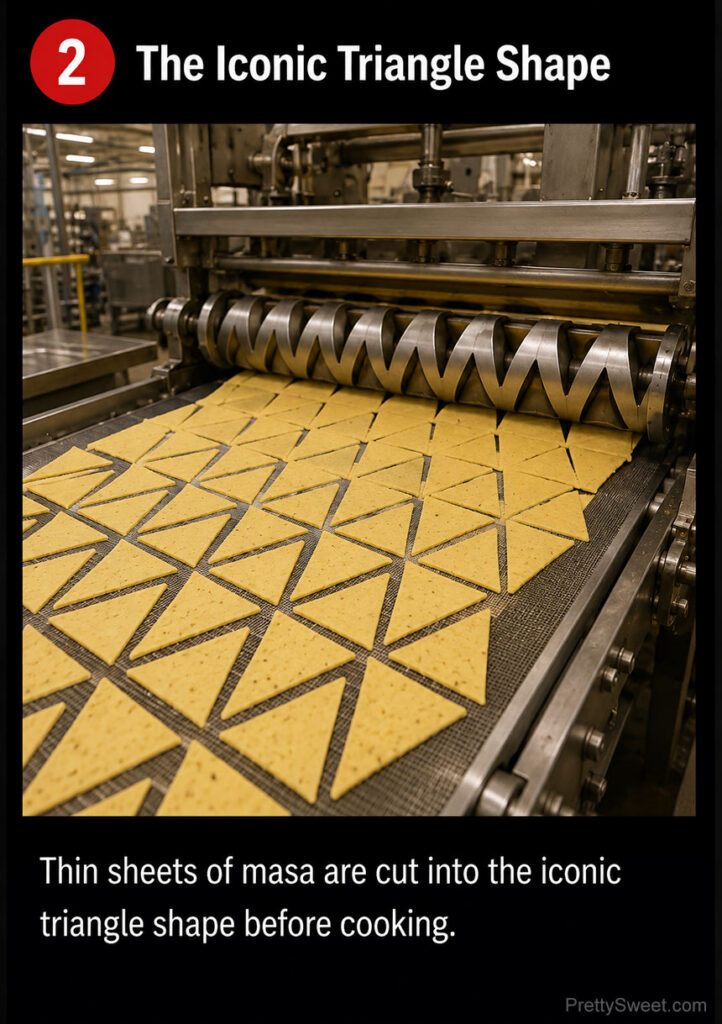
Once the Masa is ready, it’s time to get into shape! (although, getting into shape is not usually associated with Doritos!) The dough is transferred to a machine that uses a mold or “die” to cut the Masa into uniform triangles. While the triangle is the classic Doritos look, the machinery can actually be adjusted to create other shapes like rounds, squares, or rectangles.
Quality control is huge here! Any Doritos chips that are too thick, too thin, or misshapen are pulled from the line to ensure only the best make it to the next step.
Fun fact: Even the name Doritos has a flavorful origin: it comes from the Spanish word doradito, meaning “little bit of gold,” an appropriate name for those crunchy, golden triangles!
Step 3: The Golden Fry
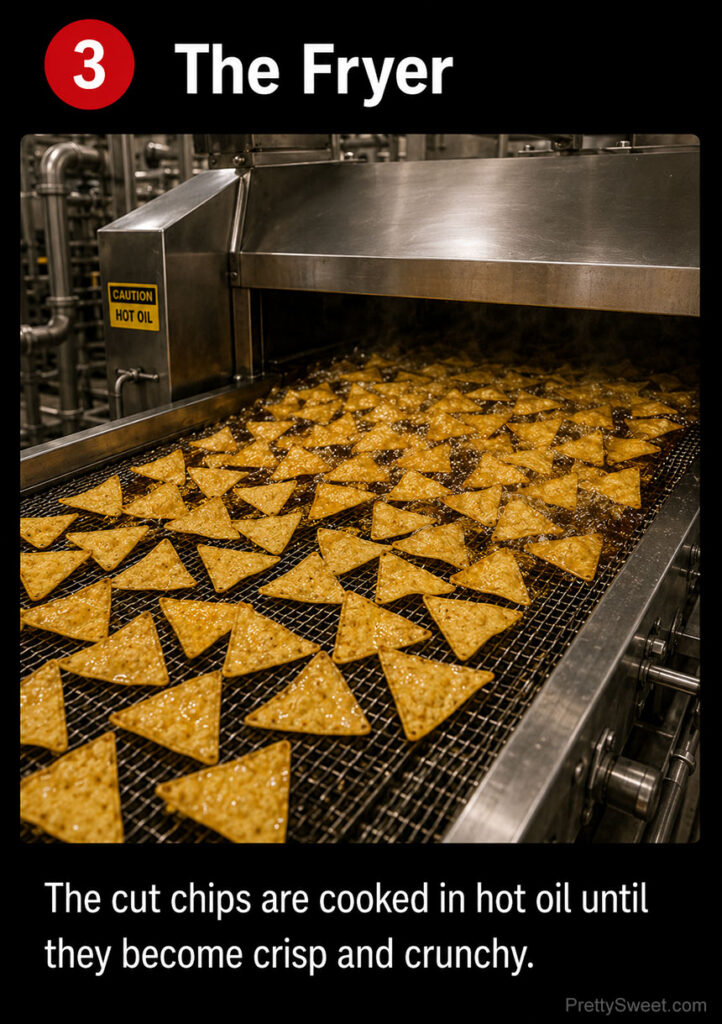
After being cut to size, the chips head to the fryer, where they are submerged in hot vegetable oil. This is a delicate stage because the temperature has to be exactly right; if the oil is too cool, the chips come out undercooked, but if it’s too hot, they’ll burn. The chips are monitored as they fry to ensure they cook evenly, giving them that perfect, satisfying crunch we all crave
Fun fact: Doritos pack more than 30 ingredients into every chip, including corn, cheddar and Romano cheeses, buttermilk, red and green bell pepper powders, monosodium glutamate, and a few ingredients most of us would struggle to pronounce. Yikes!
Step 4: The Secret Doritos Seasoning
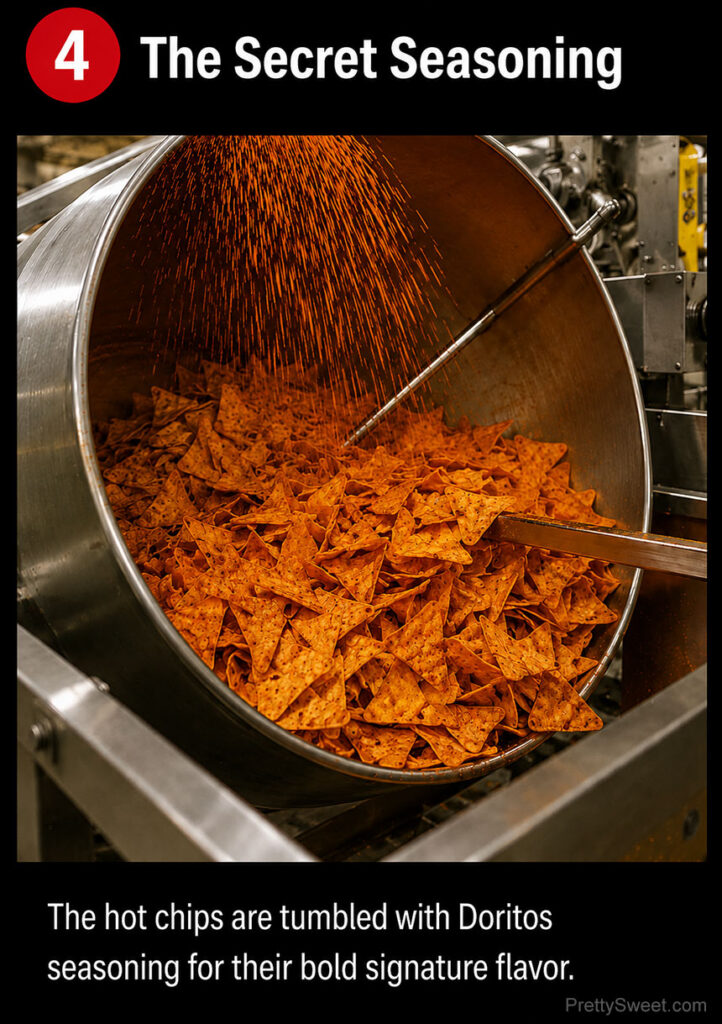
This is where the magic happens, and the chips become Doritos! Once the chips are drained of excess oil, they are seasoned with a blend of spices while they are still warm. This heat allows the flavor to penetrate the chip, creating that signature bold taste.
Whether it’s Nacho Cheese, Cool Ranch, Spicy Chili, or another of their many flavors, each Doritos flavor uses a specific combination of spices that is a closely guarded secret known only to a few. Workers and machines ensure every chip is evenly coated and meets strict weight specifications.
The first Doritos weren’t Nacho Cheese or Cool Ranch. Doritos were initially sold as plain, unflavored tortilla chips in 1966. The company later added Taco flavor, followed by the now-iconic Nacho Cheese variety.
Step 5: Packaging and Distribution
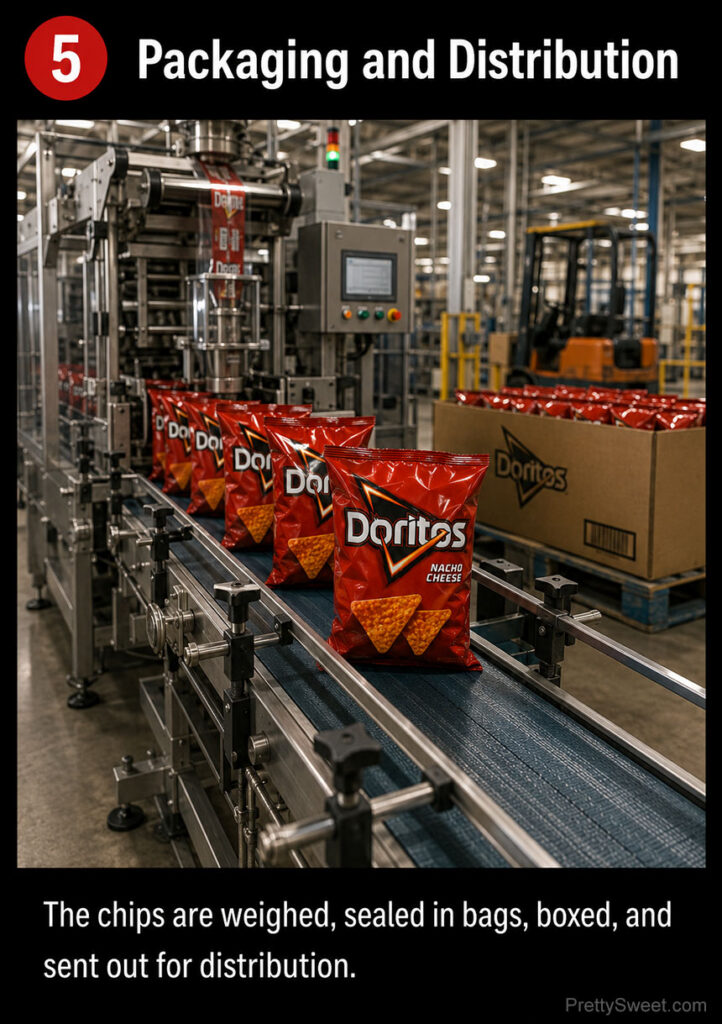
In the final stretch, the seasoned chips are sealed into airtight bags. These bags are made of high-quality materials designed to protect the snacks from moisture and air, keeping them fresh until you’re ready to eat.
The packaging isn’t just about freshness, though the bold colors and eye-catching graphics are a huge part of the branding that makes Doritos stand out on the shelf. Finally, the bags are boxed up, loaded onto trucks, and shipped to stores all over the world.
How many Doritos are made a day? Doritos factories collectively produce approximately 8 million bags each day. That figure may vary as production changes, but it gives you an idea of the enormous scale involved. That’s more than 90 bags every second! (Source: Unwrapped on Food Network)
How Doritos Are Made FAQs
Doritos are made primarily from corn, which is soaked with water and lime, then ground into masa dough.What is the main ingredient in Doritos?
Doritos were first invented in 1964 at the Casa de Fritos restaurant in Disneyland, and later introduced to the American public in 1966
Masa dough is rolled into sheets and cut into uniform triangles by specialized factory machinery that uses a die or mold to cut the dough into uniform triangles. The machine can adjust the cutting process to create rounds, squares, or rectangles for different products
Doritos are made in large Frito-Lay plants across the United States, with the biggest factories in Casa Grande, Arizona, and Perry, Georgia. Regional factories help keep distribution closer to local markets.
Making Doritos Is Serious Work!
The manufacturing of Doritos is a highly detailed process that prioritizes quality, safety, and flavor at every single turn. Every step, from the initial soaking of the corn to the final sealing of the bag, requires precision and attention to detail.
Actually, Frito Lay is very proud of every one of the millions of bags of Doritos they make. Don’t believe me? When Arch West, the man who brought Doritos to market, died in 2011, his family honored him by tossing Doritos into his grave during the burial!
Anyway, the next time you’re enjoying that cheesy, crispy Dorito-goodness, take a moment to appreciate the incredible journey that every single chip made to get to your belly.
Thanks for stopping by PrettySweet.com!

I’m a dad of four, including 3 kids and a Hungarian Vizsla who is my partner about 22 hours a day. I’m a Philly sports fan and enjoy writing about wellness, saving money, and personal finance. Thanks for reading!