
Updated for 2026: Choosing between Noom and MyFitnessPal? That’s a tough choice, and it mostly comes down to your unique personality and needs. Both app-based diets are popular and highly-rated, but they take completely different paths to help you reach your goals.
In a nutshell, Noom acts like a supportive, psychology-minded wellness coach in your pocket, while MyFitnessPal functions as a high-powered, data-driven digital food diary.
If you are trying to decide where to invest your time, energy, and money, let’s compare Noom and MyFitnessPal to decide which diet is best for your lifestyle, weight loss goals, and budget.
Core Differences Between Noom & MyFitnessPal
At first glance, both apps do the same basic thing: they log your food, track your daily steps, and monitor your weight loss timeline. However, the fundamental philosophy driving each platform could not be more distinct.
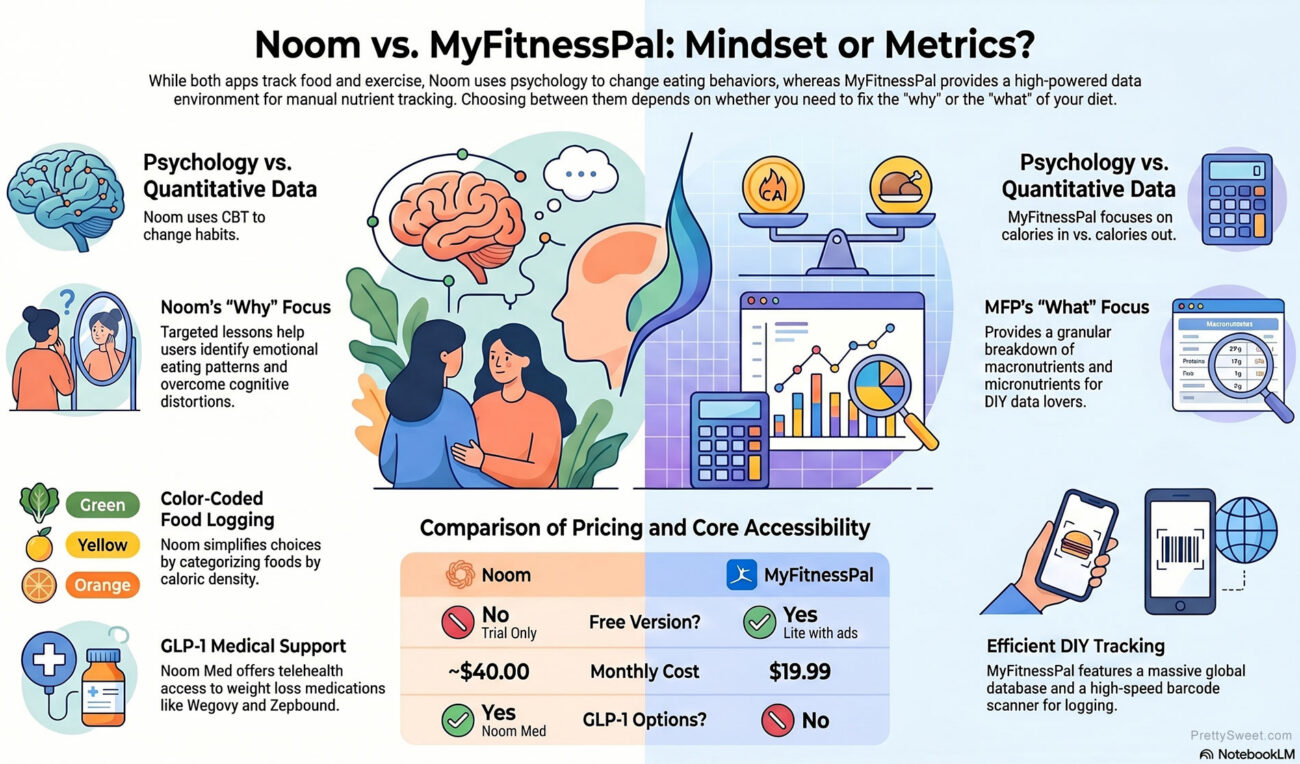
Noom is built entirely around cognitive behavioral therapy (CBT). Instead of simply telling you what to eat, Noom focuses heavily on changing your relationship with food. When you log in each day, you are greeted with short, 5-to-10-minute psychology lessons designed to help you identify emotional eating patterns, understand your triggers, and overcome cognitive distortions like “all-or-nothing” thinking.
To keep things simple, Noom categorizes food using a color-coded system (Green, Yellow, and Orange) based on caloric density—meaning how many calories a food has relative to its weight. Green foods (like veggies and whole grains) are low-density and fill you up; orange foods (like nuts and oils) are high-density and meant to be enjoyed in smaller portions. It is an approach designed to eliminate food guilt entirely.
The Noom Mindset: Noom doesn’t label foods as “good” or “bad.” Instead, it teaches you how to balance volume eating with the indulgent treats you love, so you never feel deprived.
MyFitnessPal, on the other hand, is the ultimate quantitative tracking machine. It is built on the simple, time-tested math of calories in vs. calories out. There are no daily psychology readings or structural color codes. Instead, it offers access to one of the largest global food databases in existence, complete with a highly efficient barcode scanner.
For anyone who loves data, MyFitnessPal is a dream. It gives you a granular breakdown of your macronutrients (carbs, fats, and proteins) and micronutrients. It doesn’t guide your behavior through lessons; it provides a crystal-clear, unfiltered mirror of exactly what you are consuming so you can adjust your macros to fit your personal health or fitness goals.
Noom vs MyFitnessPal Ratings:
So, what do the masses think of Noom and MyFitnessPal? The best place to find ratings for Noom and MyFitnessPal is on the Apple App Store. As you can see, both app-based weight loss programs get similar high ratings from thousands of reviews:
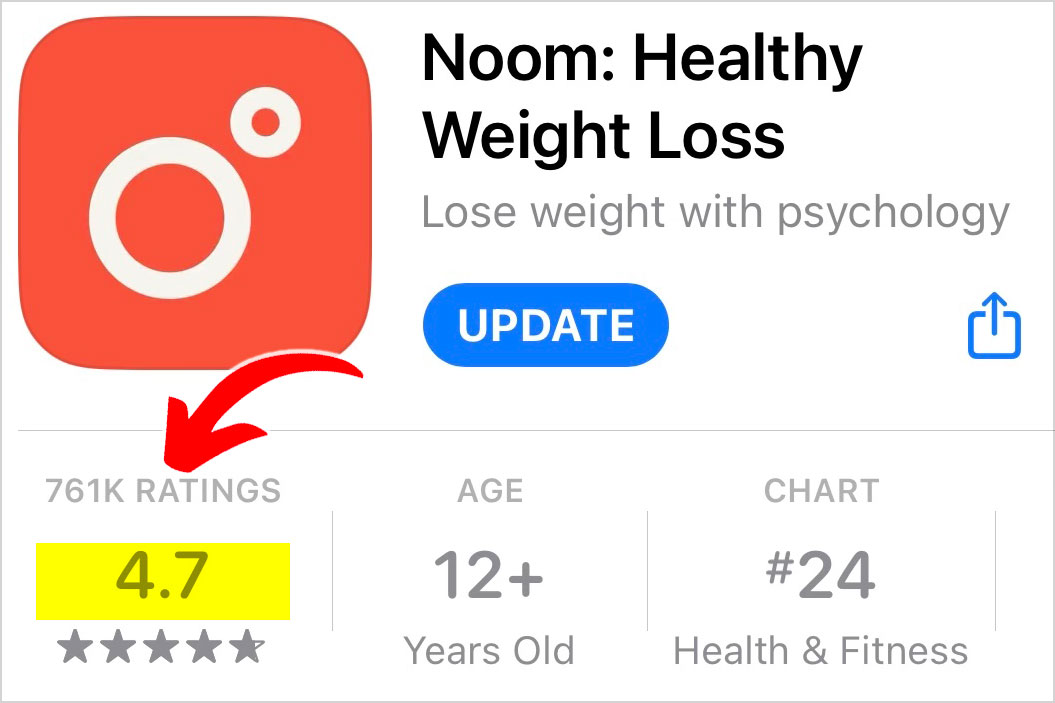
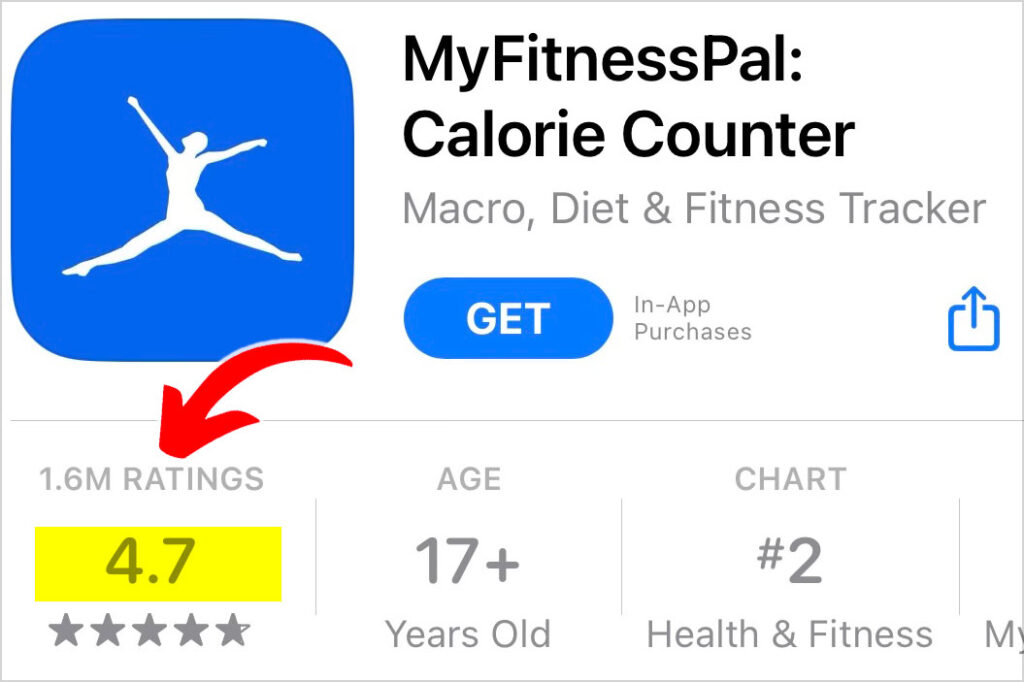
While both are rated highly, Noom offers a plan with GLP-1 support, which could be a game-changer for you.
Big Deal: Noom Med Offers GLP-1 Support!
Perhaps the most significant modern shift dividing these two apps is how they handle medical weight loss. If you are interested in incorporating weight loss medications like compounding or brand-name GLP-1s (such as Wegovy or Zepbound), Noom pulls far ahead in clinical utility through its dedicated clinical branch, Noom Med.
Noom Med connects qualifying users directly with telehealth clinicians who can evaluate them for a prescription. What makes this a standout option for women is that Noom doesn’t just hand over a prescription; they wrap the medication in a specialized “GLP-1 Companion” app experience.
Noom Med features custom behavior-change lessons specifically calibrated to help you navigate side effects, combat muscle loss through proper protein intake, and build sustainable habits so you can maintain your weight loss even if you eventually taper off the medication.
MyFitnessPal, by contrast, remains purely a self-guided tracking app. While you can certainly use it to track your food while on a GLP-1 regimen, it offers no medical matchmaking, no telehealth services, and no prescribing doctors. It’s strictly on you to manage your clinical care independently.
OK, now let’s compare Noom and MyFitnessPal pricing.
Comparing Cost and Plan Options
Budget is a major factor when choosing a tool you will use every single day. Because their offerings are so different, their pricing models reflect completely different levels of coaching and content integration.
| Features: | Noom | MyFitnessPal |
|---|---|---|
| Free Version? | No | Yes (Lite with ads) |
| Monthly Cost: | ~ $40 / month (Billed monthly) | $19.99 / month |
| Annual Cost: | $209 / year (Breaks down to $17.40/mo) | $79.99 / year (Breaks down to $6.67/mo) |
| Core Focus | Psychology, habit loops, & behavior change | Nutrient metrics, macro tracking, & data log |
| Trial Options: | 14 day free trial | 30-day Premium free trial |
| Medical GLP-1 Options? | Yes (Via Noom Med plans starting at $69-$279/mo) | No |
While MyFitnessPal offers a highly functional, ad-supported free version that millions of women use successfully without ever paying a dime, its Premium tier removes ads, unlocks deep custom macro goals by gram, and opens up priority barcode scanning.
Noom requires a financial commitment upfront. While they offer a brief introductory trial period, an ongoing subscription is necessary to access the daily psychology curriculum and coaching elements.
If you choose to step up to a Noom Med plan, pricing scales depending on your clinical path: a “Telehealth Only” route costs around $69/month (where you use your own insurance to fill a brand-name prescription at a pharmacy), while all-inclusive programs offering compounded medications directly start between $199 and $279/month.
Because Noom’s primary value lies in its structured environment, you can think of it as an investment in an interactive behavioral course.
Here are my thoughts on whether Noom or MyFitnessPal is best for your unique needs:
Choose Noom if:

- You struggle with emotional or stress eating: If you find yourself reaching for comfort food after a tough day at work, Noom’s psychological tools will help you unpack those habit loops.
- You experience food guilt: If traditional diets have left you feeling broken or ashamed when you eat a slice of cake, Noom’s non-restrictive approach can help heal that mindset.
- You want guided structure: If you thrive when you are given a clear, daily roadmap of what to read, learn, and log, you will appreciate Noom’s interactive structure.
- You want a clinical, medical weight loss path: If you qualify for and want access to GLP-1 weight loss medications alongside behavioral support to manage them safely, Noom Med is a great all-in-one program.
Related: Noom vs WeightWatchers
Choose MyFitnessPal if:
- You like data and DIY: If you want to know exactly how many grams of protein or iron you are getting every day, MyFitnessPal delivers unmatched metric clarity.
- You already know what to eat, but need accountability: If you don’t need a lesson on habits and simply want an efficient, fast way to keep your portions and total calories honest, this is your tool.
- You lean heavily into fitness and strength training: If you are lifting weights, training for a race, or coordinating your meals directly with your workouts, the deep macro customization here is essential.
- You are on a tight budget: If you want access to world-class logging features without committing to a premium price tag, the free or lower-cost tiers here are unbeatable.
So, Which App-Based Diet is Better?
Ultimately, the best program is the one that fits seamlessly into your life without causing extra stress. If you need to fix the “why” behind your eating habits, let Noom guide your mindset. If you simply need to manage the “what” and the “how much,” let MyFitnessPal handle the numbers.
You may want to consider trying both apps for free and see which one you prefer and find more useful for you. Speaking of great weight loss apps, also consider WW, which we compare to Noom here.
Do you have any opinions on Noom versus MyFitnessPal? If you’ve tried both, let us know in the comments!
Thanks for stopping by Pretty Sweet!

I’m a dad of four, including 3 kids and a Hungarian Vizsla who is my partner about 22 hours a day. I’m a Philly sports fan and enjoy writing about wellness, saving money, and personal finance. Thanks for reading!
