McDonald’s portion sizes 50’s vs now: McDonald’s opened their first restaurant in 1955 in Des Plaines, Illinois, and they offered only 9 menu items! Although the current menu has varied by region and restaurant location over the years, there are now over 150 menu items available worldwide.
The biggest change at McDonald’s compared to the 1950s is probably in their portion sizes. In most menu items the portions have more than doubled, which is certainly one of the biggest reasons we have an obesity crisis in America. Check out this 1-minute video illustrating how portions have grown at McDonald’s since the 1950s:
McDonalds: Change In Portion Sizes “1950’s vs. Now”
How have average portion sizes changed over the past 40 years?
- Burgers: When McDonalds first started serving “fast food” in 1955 their only option for a hamburger was 3.7 oz. – Compare that to today when their quarter pounders w/ cheese and Big Macs are all 7-9+ oz each! That’s a 200% increase in size!
- French Fries: Like burgers, you only had one size option in the mid-1950’s, and fries were 2.4 oz. – That’s small by today’s standards. In fact, it’s literally smaller than their “small” fries which are 2.6 oz. Portions get bigger over the years, as their large fries are now 5.9 oz. That’s a size increase of more than 240%!
- Sodas: Back in 1955 there was one size of soda, and it was a modest 7 oz. – That’s only a fraction of the size of sodas at McDonalds today, with the large soda tipping the scales at 30 oz. (That’s an increase of 400%!) If you drink the whole thing, you should know that you’ve got about 2 pounds of soda in your stomach with a shocking 97g of sugar! Sweet tea is just as bad. Yikes!
Vintage McDonalds Menu: 1950s
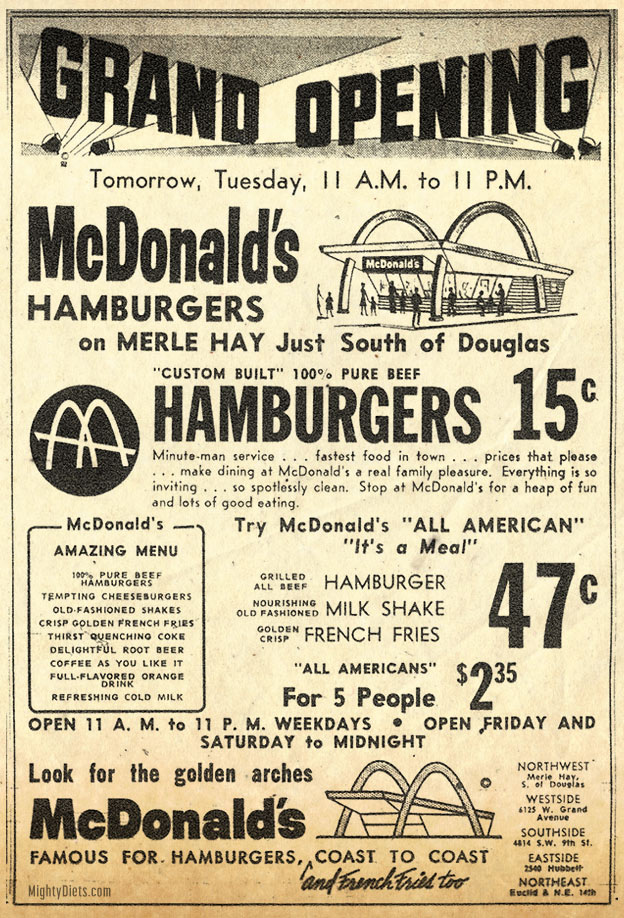
McDonald’s amazing menu! Minute-man service, fastest food in town, prices that please, making dining at McDonald’s a real family pleasure. Everything is so inviting, so spotlessly clean; stop at McDonald’s for a heap of fun and lots of good eating. (And reasonable portion sizes?!)
Did you know that the size of McDonald’s menu items is very different in America than it is in England and the U.K?It’s true, and here’s proof:
McDonalds Portion Sizes Compared to Other Countries
McDonald’s portion sizes are definitely bigger in America compared to most other countries—and you can see it clearly when you look at specific items side by side.
For example:
- French Fries: In the U.S., a large fries is about 5.9 ounces (roughly 170 grams). In the UK, a large order is closer to 2.6 ounces (about 73 grams)—that’s less than half the size!
- Soft Drinks: A U.S. large Coke is 30–32 ounces (nearly a liter). In Australia or France, a large might only be 20 ounces (600 mL).
- Big Mac Calories: Even the same menu items can vary. A U.S. Big Mac has 550 calories, while in the UK, it’s around 508 calories—not a huge difference, but it adds up.
Why are McDonalds portion sizes bigger in America? This size inflation mostly comes down to American food culture, where “value” is often tied to quantity. People expect bigger servings, and McDonald’s caters to that. Other countries have different norms around portion control and government health guidelines, which can cap serving sizes.
So yes, your combo meal in the U.S. really is supersized by comparison!
McDonalds Portion Sizes U.K. vs. U.S.
Americans like big portions, and McDonald’s is happy to oblige. Here’s a comparison of portion sizes of popular menu items like burgers and fries in the U.S. and U.K:
Obesity Rates Over the Years: 1950s vs Now
It’s no coincidence that fast food portion sizes and obesity rates were both much smaller in the 1950s. In fact, the obesity rate in the 1950s was about 10% compared to about 40% today.
That’s McScary!
Nutrition: If you Must Eat at McDonalds Today…
Speaking of “nutrition” and “McDonald’s” is a bit of an oxymoron, but if you are on a diet or just care about your health, you can use the calculator at mcdonalds.com to add up the calories, fat, carbs, and protein in your meal.
You can truly ring up a shocking number of carbs and calories on an average meal like this:
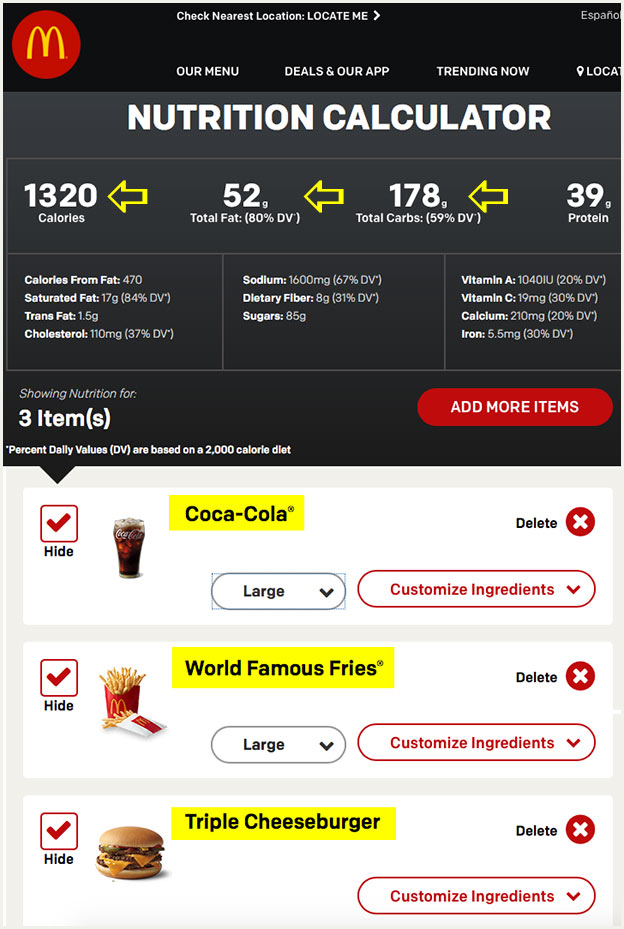
Of course, there are much better menu choices than burgers and fries, but hang around a McDonald’s for a while, and you’ll see that not many people are ordering salads or veggie burgers. (if even available!)
Much Larger Portion Sizes at Restaurants
While most of us know the difference between healthy and unhealthy food, portion size is harder to determine. Most restaurants serve portions that are much bigger than the recommended size, and it’s one of the biggest reasons why we are overweight.
McDonald’s isn’t the only culprit with portion sizes, as most restaurants now serve portions twice as big as our parents’ generation. At first, these pre-portioned meals can look comically small until you realize that they are the correct size, and what we are used to is actually super-sized!